
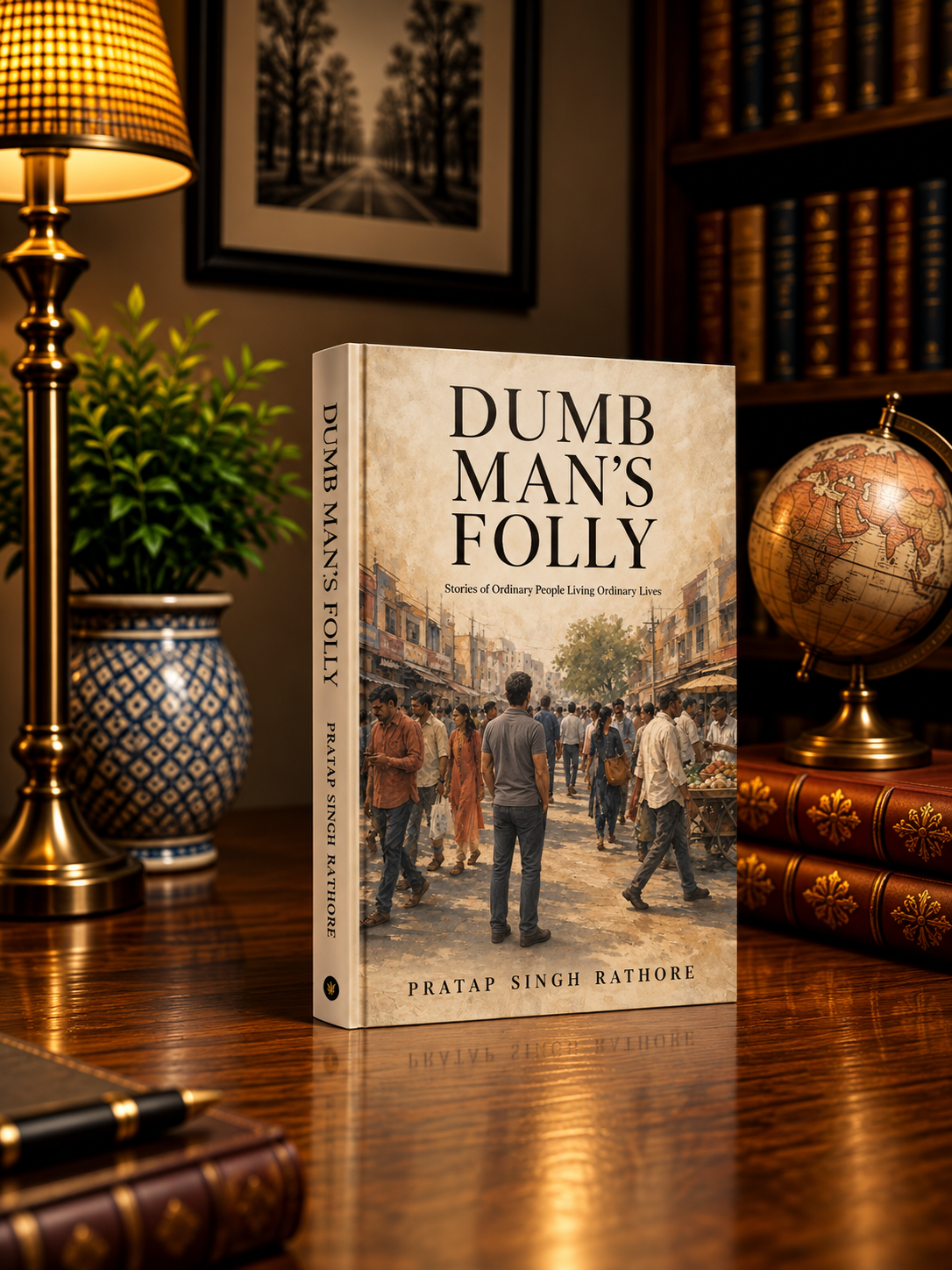
DUMB MAN’S FOLLY
DUMB MAN’S FOLLY by PRATAP SINGH RATHORE is a thought-provoking collection of ten short stories that looks beneath the surface of ordinary life to explore morality, responsibility, freedom, faith, ambition, and the difficult choices people make.
Rather than presenting a world of perfect heroes and obvious villains, the collection focuses on ordinary people—workers, parents, children, neighbours, officials, and devotees—who find themselves navigating situations that are rarely simple.
Their stories reveal an important truth about human behaviour: doing what seems right is not always as straightforward as it appears.
THE COMPLEXITY OF ORDINARY LIFE
The characters in DUMB MAN’S FOLLY are recognisable because their struggles are rooted in everyday experiences.
They face responsibilities, personal ambitions, social expectations, relationships, and circumstances that force them to make difficult choices. Their decisions often exist somewhere between right and wrong, leaving readers to consider the reasons behind their actions rather than judging them immediately.
The collection does not always provide clear answers. Instead, it allows situations to remain complicated, encouraging readers to form their own conclusions.
FREEDOM AND RESPONSIBILITY
One of the book’s central themes is the relationship between freedom and responsibility.
What does freedom truly mean if power continues to remain in the hands of the same people? And how much responsibility should individuals carry for the consequences of their choices?
These questions become particularly interesting when explored through ordinary lives rather than abstract philosophical arguments.
The stories demonstrate how freedom and responsibility are often connected. The ability to make choices also brings the responsibility to understand their consequences.
EQUALITY AND ACCOUNTABILITY
The collection also raises questions about equality and accountability.
Can equality exist without equal responsibility? What happens when individuals expect fairness but are unwilling to accept the responsibilities that accompany it?
By placing these questions within relatable situations, PRATAP SINGH RATHORE transforms philosophical ideas into human experiences that readers can examine from different perspectives.
FAITH, AMBITION AND HUMAN MOTIVATION
Faith and ambition form another important thread throughout the collection.
People often act according to beliefs they consider meaningful, but personal ambition can sometimes influence those beliefs and decisions. The boundary between genuine faith and personal desire is not always easy to identify.
DUMB MAN’S FOLLY does not attempt to define that boundary for the reader. Instead, it presents situations that encourage reflection on why people behave the way they do.
WHAT WE SEE AND WHAT WE DON’T
One of the most compelling ideas in the book is that people are often far more complicated than they appear.
A person’s public identity may reveal only a small part of their life. Behind familiar roles can exist private fears, ambitions, doubts, responsibilities, and moral conflicts that others may never see.
This creates a powerful question: how much of another person’s life can we truly understand from what they allow us to see?
The stories encourage readers to look beyond appearances and consider the unseen circumstances that may influence human behaviour.
THE GREY AREA BETWEEN RIGHT AND WRONG
DUMB MAN’S FOLLY is particularly interested in moral ambiguity.
An action that appears justified from one perspective may seem questionable from another. A decision made with good intentions can still produce unexpected consequences.
This complexity gives the stories their reflective quality.
Rather than telling readers what they should think, the author places them in situations where they must consider motivations, circumstances, consequences, and competing perspectives.
THE SIGNIFICANCE OF EVERYDAY CHOICES
Not every life-changing decision arrives as a dramatic moment.
Sometimes, the choices that shape a person’s future are small decisions made within a family, workplace, community, or relationship.
Over time, these seemingly ordinary choices can influence relationships, opportunities, responsibilities, and personal identity.
By focusing on everyday people, the collection highlights the significance of these moments and reminds readers that ordinary decisions can carry extraordinary consequences.
ABOUT THE AUTHOR
PRATAP SINGH RATHORE is a Master Mariner and author who has spent more than two decades at sea, commanding merchant vessels across international waters.
Born and raised in Jaipur, Rajasthan, his professional life has exposed him to environments where discipline, responsibility, decision-making, teamwork, and human behaviour play an important role.
Alongside his maritime career, Rathore has been an avid reader for more than twenty years. His literary interests include historical and philosophical fiction, with influences from writers such as Munshi Premchand and Ayn Rand.
His writing reflects this interest in understanding not only what people do, but also why they make particular choices and how those choices reveal their relationship with society, morality, responsibility, and themselves.
A TITLE THAT INVITES QUESTIONS
The title DUMB MAN’S FOLLY itself carries an element of ambiguity.
An idea that appears foolish may sometimes contain an overlooked truth. At the same time, what appears to be wisdom can eventually reveal itself as misguided.
This uncertainty is reflected throughout the collection.
The author allows readers to question assumptions rather than offering convenient conclusions. The result is a reading experience in which the audience becomes an active participant.
A BOOK THAT LEAVES THE JUDGEMENT TO THE READER
DUMB MAN’S FOLLY is ultimately less interested in providing answers than in encouraging better questions.
Its ten stories explore freedom and responsibility, equality and accountability, faith and ambition, appearance and reality, and the difference between wisdom and folly.
The collection reminds readers that human behaviour cannot always be understood through simple labels.
There are no completely perfect heroes and no conveniently defined villains. There are people, circumstances, choices, and consequences.
EDITORIAL VERDICT
DUMB MAN’S FOLLY is an engaging collection for readers who enjoy philosophical fiction, social observation, and stories that leave room for interpretation.
PRATAP SINGH RATHORE brings together ordinary characters and complex situations to explore the moral questions hidden within everyday life.
The book’s greatest strength lies in its willingness to let readers decide. Instead of delivering easy lessons, it encourages reflection on what we consider right, what we assume about others, and how our choices shape the lives we lead.
For readers looking for stories that entertain while also challenging their assumptions, DUMB MAN’S FOLLY offers a thoughtful and reflective literary experience.
★★★★★ 5/5 | HIGHLY RECOMMENDED
AUTHOR: PRATAP SINGH RATHORE
BOOK LINKS:
Amazon:
https://www.amazon.in/dp/B0HF8FQQH4
Flipkart:
https://www.flipkart.com/dumb-man-s-folly-stories-ordinary-people-living-lives/p/itmc58d54bdc00c6?pid=9798906431516
Notion Press:
https://direct.notionpress.com/in/read/dumb-man-s-folly
AUTHOR WEBSITE:
https://authorpratap.com/
INSTAGRAM:
@author.prataprathore